
On this page
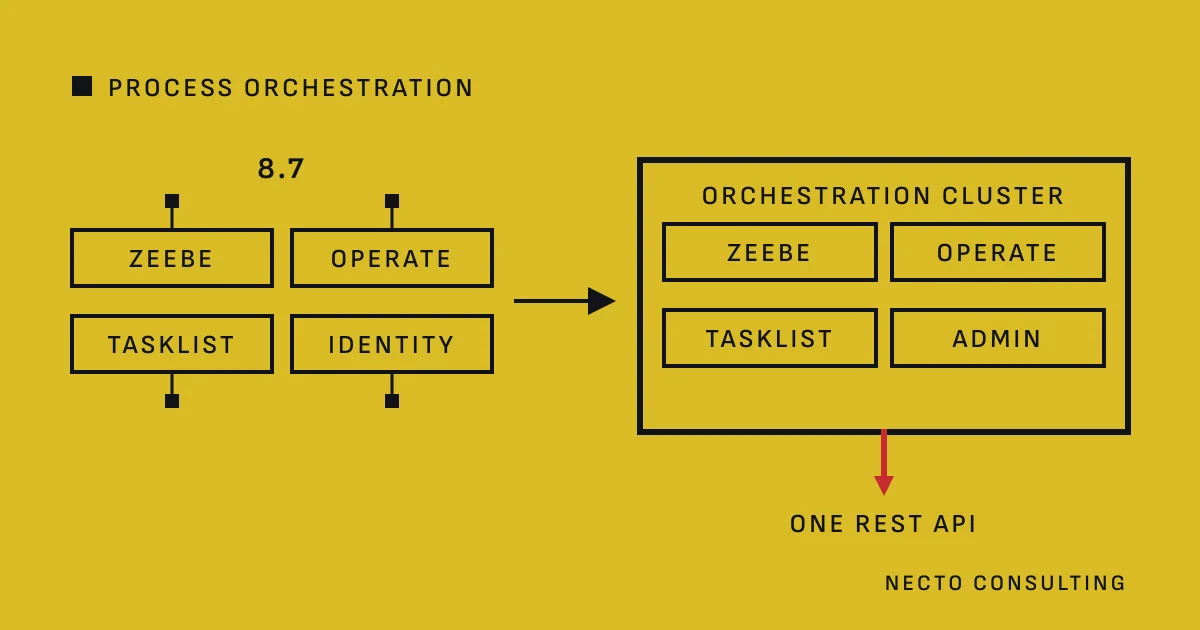
The Camunda 8 Orchestration Cluster is one application where there used to be four. From Camunda 8.8, released on 14 October 2025, Zeebe, Operate, Tasklist and Identity run together, with one REST API, one authorization model and one version number. For your team, that means fewer deployments to run, one API to integrate against and a planned upgrade from 8.7.
What the Orchestration Cluster bundles, and what stays outside
#Camunda 8.8 integrates four components into the Orchestration Cluster application, distributed as a JAR file or a Docker container:
- Zeebe, the engine that runs your BPMN processes.
- Operate, where you watch running instances and resolve their incidents.
- Tasklist, where people work on their user tasks.
- Identity, renamed Admin in 8.9, which holds the cluster's users, groups, roles, tenants and authorizations.
The components must run on the exact same minor and patch level. They ship as one Docker image: Camunda deprecated the separate Zeebe, Operate and Tasklist images in 8.8 and no longer produces them from 8.10, released on 13 October 2026.
Optimize and the connectors stay outside the cluster. In 8.10, Camunda Hub replaces Console and Web Modeler.
How does the Orchestration Cluster change operations?
#For a Self-Managed installation, the cluster replaces several deployments with one, upgraded as one. The changes an operations team plans for:
- One version for the core. A partial upgrade, Zeebe first and Operate later, is no longer possible. You test and roll out the cluster as a whole.
- One configuration. 8.8 began a shared configuration schema for the cluster, and Camunda says 8.10 completes it. A team that upgrades from 8.7 maps its old component properties to the new names.
- Infrastructure you run yourself. The 8.10 Helm chart (chart 15.x) no longer bundles the Bitnami subcharts for PostgreSQL, Elasticsearch and Keycloak. A production installation brings its own database, search cluster and identity provider.
- Physical tenants, from 8.10. One cluster can hold tenants whose data is stored separately, each with its own roles and permissions. They share the cluster's CPU and memory, so Camunda describes the isolation as reducing interference between tenants, not removing it.
One REST API in place of four
#The Orchestration Cluster REST API replaces the Operate API, the Tasklist API, the Zeebe API and much of the Identity API. An application that starts processes, queries instances and completes user tasks talks to one endpoint with one way of authenticating.
The old component APIs have a timeline. The Operate and Tasklist v1 REST APIs were deprecated in 8.8, still available in 8.9 and removed in 8.10; the Tasklist GraphQL API was already removed in 8.8. An integration still built on them stops working on 8.10 and has to move to the unified API first.
The Camunda Java Client, which replaces the Zeebe Java client, uses REST by default and can be switched to gRPC. The 8.10 release notes say the Zeebe Client is removed. How job workers behave on the new client is covered in Camunda 8 job workers in Java.
Who may do what: the new authorization model
#The cluster has one authorization model for its engine, Operate, Tasklist and API. An authorization grants an owner permissions on a resource. An owner is a user, a group, a role, a client or a mapping rule, and resources include process definitions, user tasks, decision definitions and tenants.
Two rules shape the work:
- Nothing is allowed by default. When authorizations are enabled, every permission has to be granted explicitly, and there are no deny rules. Camunda enables the checks by default for a cluster migrated with the Helm chart.
- The model ends at the cluster. Camunda says these authorizations do not apply to Optimize or Camunda Hub, which keep their own access control.
For a bank or an insurer, this is where an access concept gets written down: which group may start which process, who may see which tasks, which technical client may do what.
Do we still need Keycloak?
#Not for the Orchestration Cluster. Camunda 8.8 says Management Identity, Keycloak and Postgres are no longer needed for it, and treats Keycloak as one external identity provider integrated through OIDC. The cluster supports three authentication modes: no authentication, Basic authentication and OIDC, so the identity provider a company already runs can take Keycloak's place through OIDC.
Two consequences for an upgrade:
- LDAP authentication for Operate and Tasklist is no longer supported from 8.8. Users move to OIDC or Basic authentication.
- With Basic authentication, users are recreated in the cluster, and Camunda warns that the usernames must be identical, otherwise people will not see the tasks assigned to them.
Elasticsearch, OpenSearch or a relational database?
#The cluster writes what Operate and Tasklist show to a secondary storage, through the Camunda Exporter introduced in 8.8. From 8.9, released on 14 April 2026, that storage can be a relational database instead of Elasticsearch or OpenSearch: Camunda lists PostgreSQL, Oracle, MariaDB, MySQL, Microsoft SQL Server, H2 and Amazon Aurora. 8.10 adds support for asynchronously replicated databases, including Aurora and PostgreSQL.
Choose with Optimize in mind:
- Optimize is not supported with a relational backend. A team that uses Optimize runs Elasticsearch or OpenSearch for it, even when the cluster itself uses a relational database.
- One exporter or the other. The Camunda Exporter and the relational exporter are mutually exclusive; only one can be enabled at a time.
- Minimum versions. From 8.9, Elasticsearch 8.19 or OpenSearch 2.19 at least.
For a team that already runs PostgreSQL or Oracle and has no search cluster, the relational option removes one system to operate.
How to plan the upgrade from Camunda 8.7 to 8.8
#The 8.8 upgrade guide for Self-Managed sets an order, and some steps cannot be undone:
- Consolidate onto one Elasticsearch or OpenSearch cluster. Camunda says this must be completed before all other steps.
- Migrate custom index prefixes to a common prefix, with a backup and downtime first: the change is irreversible, and the cluster must not be restarted on 8.7 afterwards.
- Drain the importer backlog and convert API objects that use
int64keys tostringkeys. - Run the Identity Migration Application, which moves roles, groups and tenants to the cluster's authorizations.
- Upgrade to 8.8, then run the data migrations and turn the importers off once they are complete.
Plan the disk as well. The default number of replicas for Camunda's indices goes from 0 to 1, and Camunda advises at least 2.5 times the storage used before. One client detail decides the order of the rollout: a Zeebe Java client 8.7.15 or earlier with REST explicitly preferred is incompatible with 8.8, so clients move to 8.7.16 or later before the cluster is upgraded.
A team still on Camunda 7 skips this step and lands on the cluster directly; what changes in its models, code and data is in Camunda 7 to 8: what changes.
Which version to target, and for how long it is supported
#Camunda gives each minor version 18 months of standard support from its release date:
| Version | Released | Standard support ends |
|---|---|---|
| 8.8 | 14 October 2025 | 13 April 2027 |
| 8.9 | 14 April 2026 | 12 October 2027 |
| 8.10 | 13 October 2026 | 11 April 2028 |
A team that starts an upgrade in November 2026 and finishes it in 2027 lands inside 8.10's window with the most room. A target of 8.8 leaves five months of standard support from 14 November 2026, less than many upgrade projects take.
Questions
What is the Camunda Orchestration Cluster?
The Orchestration Cluster is the core of Camunda 8 from version 8.8: Zeebe, Operate, Tasklist and Identity (renamed Admin in 8.9) integrated into one application, distributed as a JAR file or a Docker container, with one REST API and one authorization model.
Do we still need Keycloak for Camunda 8.8 or later?
Not for the Orchestration Cluster. Camunda 8.8 says Management Identity, Keycloak and Postgres are no longer needed for it, and treats Keycloak as one external OIDC identity provider among others.
Can Camunda 8 use a relational database instead of Elasticsearch?
From Camunda 8.9, the Orchestration Cluster can use a relational database as its secondary storage, including PostgreSQL, Oracle, MariaDB, MySQL, Microsoft SQL Server and Amazon Aurora. Optimize is not supported with a relational backend, so a team that uses Optimize keeps Elasticsearch or OpenSearch for it.
How long is a Camunda 8 minor version supported?
Camunda gives each minor version 18 months of standard support from its release: 8.8 until 13 April 2027, 8.9 until 12 October 2027 and 8.10 until 11 April 2028.
